Magic Lantern Festival – London

Last year I was delighted to be able to banish the winter blues, albeit temporarily, with a visit to Lumiere London. This light festival saw buildings in Central London used as a canvas for enormous illuminated projections that lit up the cold night skies. I wrote about it in my blog here: lumiere London. The festival proved hugely popular, with thousands of people taking to the streets to see the illuminations; however this popularity was also its downfall, as the hoards of people thronging the streets caused huge traffic and pedestrian chaos, showing that Central London was not really the ideal venue for such a festival.

I hoped that Lumiere London would return to the city again this year, although I feared it would not due to the problems mentioned above. So I was thrilled to see that another light festival was taking place in 2017, this time in the spacious grounds of Chiswick House where there was room for large crowds to visit the festival. This Magical Lantern Festival had already been held before Christmas in Birmingham and Leeds, at the same time, before coming to London to mark the celebration of the Chinese New Year. The scale of the London festival was huge, I wondered if it was an amalgamation of the Birmingham and Leeds festivals or if they had two of each installation. I found out from their website that the festival was actually conceived in October 2015, and shown for the first time last year in Chiswick House, where it was visited by 110,000 people.

I also learned from their website that “Chinese Lantern Festivals span a rich 2000-year heritage. As early as the Western Han Dynasty (206 BC-AD 25), it had become a festival of great significance. During the Lantern Festival, children go out at night to temples carrying paper lanterns and solve riddles on the lanterns. During the Tang Dynasty (618 AD), the tradition grew, lanterns were not only put up everywhere in the palace and along the streets, but were also used to build big festival lantern wheels, buildings and even trees.

In ancient times, the lanterns were fairly simple, only the emperor and noblemen had large ornate ones. In modern times, lanterns have developed greatly and have become works of art embellished with many complex designs. Lanterns symbolize people letting go of their past selves and entering new ones, which they will let go of the following year. The lanterns were almost always red to symbolize good fortune.”

I visited the Magical Lantern Festival on Saturday 4 February, and it certainly was magical! It was also extremely popular, perhaps because it was a Saturday night and maybe on week nights it is not so busy. On arrival, there is a grand entrance and then illuminations all along a walkway before you get to the point at which you have to show your ticket. At this point my heart sank as there was an enormous queue to get past the ticket checkpoint. However, although there was a long queue here, and for the café and bar immediately through the entrance, once you actually got into the festival although it was busy it was not so packed that you couldn’t enjoy it. The installations were also so huge that you could always get a good view and find the space to get a clear sightline to take photos.

The lanterns are displayed in tableaux, with different themes that were quite abstract. There were some illuminated display boards that explained the themes although with some quite interesting translations from the Chinese language that appeared first on the boards! The themes ranged from the story of Aladdin, depictions of Paris, London and the ‘Mediterranean’, through to Chinese temples and a celebration of Chinese cookery with a giant noodle bowl and bottle of soy sauce – although this display also featured a chef making pizza which seemed a little incongruous!  There is only one way around the festival, the route snaking around so that you pass every display. At the end of the route is an ‘entertainment area’ where there is a fairground wheel, skating, an ice bar and various concession stands where you can buy food and drink.

No words do the festival justice though, and even the photos do not really convey the sheer size and scale of the lanterns. I would thoroughly recommend going to see it if you get the chance; and I hope it returns next year for a third year running.


Posted in Art, London, Uncategorized | Tagged , , , , , , | 1 Comment

Yorkshire 3 Peaks

Having booked to walk the Inca Trail with a friend later in the year, I was looking to spend a few weekends training for the uneven steps and long periods of uphill that I’m going to experience in Peru. Yes, I could spend hours on the stairmaster at the gym, but where’s the fun in that? I mentioned this to my brother who lives in Yorkshire, and he suggested walking the Yorkshire 3 Peaks as a good training session. I put google to good use and found out the Y3P are Pen-y-ghent, Whernside and Ingleborough, which are all situated in the Yorkshire Dales near the picturesque village of Horton-in-Ribblesdale.

IMG_nfsame

There is a challenge – which many people undertake, sometimes for charity – of tackling all three peaks in one go in less than 12 hours. As this challenge involves just slightly short of a marathon distance (24 miles) and a lot more up and down, this seemed a bit tough for a novice walker without doing a lot of training first. But I thought that doing one peak a day over a bank holiday weekend would surely be possible. I took to twitter for advice, and initially regretted it as the first response I got was from someone asking me why I wasn’t doing them all in one go, making me think that I would be spending a weekend surrounded by hardened yompers who would pour scorn on me for doing a measly one peak a day. But then I got a response from the Yorkshire Dales National Park Authority who suggested that I bought their official Y3P app. This app turned out to be a godsend; it had the routes clearly laid out for each of the three peaks, with maps frontloaded so that they were available even when there was no phone signal (which turned out to be virtually the whole area!), and lots of practical tips and advice. And money from the sale of the app goes towards maintaining the paths on the 3 peaks so I was happy to contribute.

Horton-in-Ribblesdale seemed the obvious place to stay with options ranging from camping and bunk houses through to boutique B&Bs.  We chose Horton Villa B&B and am very glad that we did as not only was it supremely comfortable with a top-notch breakfast, but it also had a hot tub which proved to be a godsend! We hadn’t realised this when I booked so hadn’t brought swimming things, but after the first day of walking I was so grateful for the hot tub to ease my aching muscles that we went in wearing t-shirt and shorts and it was absolute bliss! Amos who runs the B&B is a keen walker and what he didn’t know about the Y3P you could write on a pinhead. He lent us walking poles, made us up a packed lunch to take with us each day, photocopied the route map for us and correctly anticipated the time it would take us to walk each peak.

Most people do the Y3P in an anticlockwise direction starting with Pen-y-ghent, which many feel is the easiest although it is more straight-up-straight down than the others. Because we were getting the train back to London in the afternoon of day 3 we decided to save this one for last in the hope we could do it in a morning, and on the advice of Amos who assured us that we could! We decided to tackle Ingleborough first; many people rate this as the hardest so we thought we’d get it out of the way first.

Ingleborough (723 m or 2,372 ft)

Refreshed after a good night’s sleep and an excellent breakfast to set us up for the day, we were all ready to tackle our first peak of Ingleborough. The app had a circular 10-mile route that started and finished from the car park in nearby Clapham, but as we had no car we took the route that leads from behind Horton station and goes in a virtually straight line all the way to the summit and back. I followed Amos’ advice to “be bold, start cold” and set off in a t-shirt, but the weather was really nice and I didn’t need to put on warmer layer until stopping on the summit to have lunch. Because most people doing the challenge do Ingleborough last there were relatively few people doing this route, so it came as a surprise when we got to the summit to find there were many people on the summit who had arrived from other routes. The route we took is relatively gentle with just a short very steep bit at the end that requires a bit of scrambling. It took us about 6 hours in total – we took it easy with various breaks when needed – but I have to admit I had very achy muscles as we came back and was extremely glad of a long soak in the hot tub to ease the aches and pains!


Whernside (736 m or 2,415 ft)

Day 2, and with aching muscles we set off to tackle Whernside. Anne from the B&B kindly gave us a lift over to the start at Ribblehead, and we did the 7.5 mile circular walk described on the app.  This route starts near the impressive Ribblehead viaduct and runs alongside the railway line before crossing the railway and starting the long gradual climb up the peak. At the top there is a lovely long ridge with spectacular views of Ingleborough and the Ribble valley. After a short lunch stop at the summit there is a steep descent followed by a final flat section to finish underneath the Ribblehead viaduct again. As we were descending we saw the train cross the viaduct and wondered if the next train would be in an hour’s time, having not looked up the train times in advance but thinking that it would be perfect if it was. The train times are displayed in the Station Inn; with the pub itself being a sight for the sore eyes of walkers with sore legs, but it was only then that we found out there were only 4 trains on a Sunday and the next one was not due for several hours. Normally I would have been happy to stay in the pub and have a few drinks to aid recovery, but I had some friends who I had not seen for ages turning up at Horton only an hour later and I had no way of getting in touch with them. So the pub kindly rang for a taxi and we found a couple in the pub who also needed to get back to Horton who were willing to share the extortionate cost with us. With hindsight it would have been better doing Whernside on the Saturday when there were more trains, or at the very least looking up the train times beforehand!  However, we were blessed with gorgeous weather on the Sunday – the nicest of the weekend – that resulted in me getting sun-burnt ears despite liberally applying the Factor 50!


Pen-y-ghent (694 m or 2,277 ft)

We saved the supposed “easiest” peak ’til last – Pen-y-ghent. Pen-y-ghent is right behind the village but there is a circular walk that was pretty much straight up once side and down the other side with a short ridge at the top. Unlike the day before the day was misty and cloudy, so when we reached the summit we saw absolutely nothing of the view! There is a steep scrambling section just before the summit so in some respects it was a good job we couldn’t see over the edge or our nerve may have left us! It took us 2 hours to get up to the summit – as opposed to the 40 minutes it took a runner who asked me to take his photo at the top!

We celebrated having successfully completed all 3 peaks with a well-earned drink and Sunday lunch in the pub before getting the train back to London. It was tough and certainly was a challenge even though we did them spread over 3 days – I don’t know how people manage to do them in one day! But they are certainly achievable and enjoyable, even as a novice walker, and it was so refreshing to get out of London and up into the Dales – brilliant stress-release – and I would recommend them to any keen or even novice walker.

https://en.wikipedia.org/wiki/Yorkshire_Three_Peaks

Posted in Travel, Uncategorized, Walking | Tagged , , , , , , , | Leave a comment

The Driver’s Seat

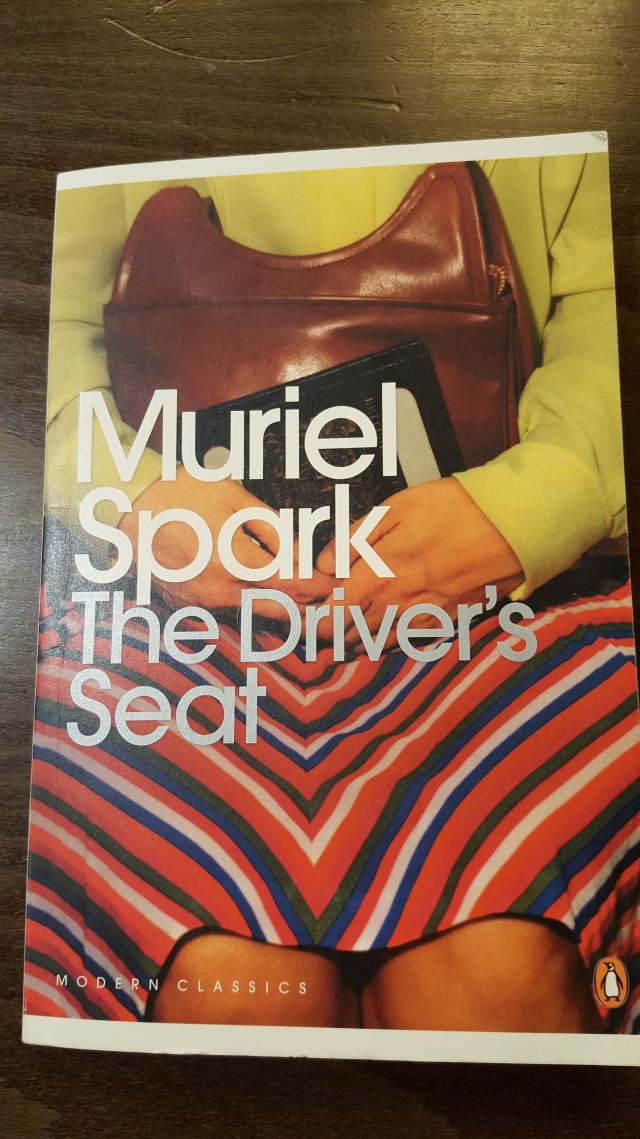
The chosen book for June’s meeting of the Walthamstow Waterstones monthly Book Group was The Driver’s Seat by Muriel Spark. I hadn’t read any books by Muriel Spark before, but saw the film of “The Prime of Miss Jean Brodie” many years ago and enjoyed it. The book is published in the Penguin Modern Classics series, and David Lodge on the back cover described it as “an extraordinary tour de force, a crime story turned inside out”, so I settled down to read it in anticipation of a good read. And sometimes it doesn’t pay to read the blurb on the back first as it just increases expectation. I honestly think David Lodge must have been reading a different book to the one I read, as I even doubt that it would have been published at all if it had been written before the Prime!

The Driver’s Seat is a thin novel, at just over 100 pages long, so it suited the book group which doesn’t like to choose hefty tomes in case people don’t finish the book and then don’t attend as a result. The story is of a woman in her 30s, called Lise, who has worked in an accountants’ office for 16 years and who takes a trip overseas that ends in her death. We find out very little about her life apart from this, but the implication is that she is fairly mousy and non-descript, and the journey on which she embarks is massively out of character. It’s not giving anything much away by saying that her overseas trip ends in her death, as chapter 3 starts: “She will be found tomorrow morning dead from multiple stab-wounds, her wrists bound with a silk scarf and her ankles bound with a man’s necktie, in the grounds of an empty villa, in a park of the foreign city to which she is travelling on the flight now boarding at Gate 14.” Repeatedly throughout the novel Spark reminds us that Lise will be found dead, bringing us back to her grisly future whenever the narrative focusses on her rather strange present and whenever a new character is introduced. It seems a rather clunky way of overly-signposting that this is a sort of whodunit, and leading the reader to question if each new character Lise meets will turn out to be the murderer.

The book was chosen for the June meeting by Simon, who runs the group, and he started the discussion by declaring that it was possibly the strangest book he had ever read. It turned out that he had read the book before selecting it as a book group choice, which I found interesting. When I suggest a book for the group I try to choose books that I think everyone will enjoy, enjoyment being my sole criterion for book group selection. But The Driver’s Seat was such a strange book that it prompted much discussion as well as widely varying opinions, so I guess that this did make it a good book choice (as well as being short!). At the end of the discussion we always rate the book out of 10, and the ratings for TDS ranged from 3 (my score!) to 8, with an average score of 6/10.

The reason I gave it such a low score was that I thought it was incredibly badly written and I didn’t enjoy it at all. I only continued reading it partly because I was going to the book group meeting and partly to find out ‘whodunit’, and then in the end it was such a disappointment with such a bad ending that I wished I hadn’t bothered. There are a number of clunky narrative devices, like the incredibly obvious signposting that goes on throughout the book. But the main reason I didn’t enjoy it is that I didn’t find any of the characters at all believable. I could accept it if it was just Lise who acts in an extraordinarily bizarre manner, and whose language and conversation is extremely unnatural, as I would put it down to the psychological makeup and/or mental health of the character. However, when ALL the characters are bizarre in both speech and actions, it just seems unbelievable. One of the people in the group thought that the whole book was like a dream sequence with characters doing unexplained things and appearing and disappearing without explanation. I have also previously pondered on the fact that I seem to have to like – or at least  empathise – with the main character in order for me to enjoy the book, and in this book I found Lise not only unbelievable but also extremely objectionable.

The title of the book prompts you to ponder just who is in the driver’s seat? The phrase only appears once in the book, in one of the many ridiculous episodes and where Lise is in a taxi sitting behind the driver’s seat. This led to a discussion about whether the book was trying to make a feminist point about the position and role of women in society. Was Lise in the driver’s seat of life, and the author of her own destiny? Was it a supposed to make you question whether women should behave as Lise did? There is a huge emphasis on the garish clothing that Lise chooses to wear, with clashing colours that leads to her being described as a ‘clown’ by one character, and this clothing combined with the disparity in Lise’s character when she is at work – where she is subservient and bursts into tears – and her character abroad where she seems confident and takes charge, perhaps is intended to make you think that Lise is “up for it” and question whether this is appropriate behaviour. Does her behaviour lead to her death? The book seemed very dated to me, and I was surprised to find that it was published in 1970, but maybe she wrote it far earlier than it was published, at the height of the swinging sixties. The blurb on the back cover describes Lise as a “garishly dressed temptress” and also states that she is in search of “adventure, sex and new experiences”.  Yet despite Lise seeking a man that she repeatedly refers to as her “boyfriend” and the phrase “not my type” being almost hammered home, Lise actually rejects all offers of sex and is anything but the promiscuous temptress that the back cover would have you believe – Lise is seeking something else altogether.

I was astonished to find out that in 2008 Muriel Spark took 8th place in a Times list of the greatest writers since 1945 and in 2010 the Driver’s Seat was short listed for the ‘Lost’ Booker Prize (a selection of books that might have won the award in 1970 but were excluded because of a change in the rules). To me, the only thing that it had going for it was that it was an easy read, and you did want to find out who killed Lise and how. The Driver’s Seat seemed like really poor quality student writing, that a teacher like Miss Jean Brodie would return with “could do better” written firmly across it. My copy is going into one of the Little Free Libraries that are dotted around Walthamstow, so if you find it, you have been warned!

wp-1465131473288.jpg


Posted in Books, Reviews, Uncategorized, Walthamstow | Tagged , , , , , , , | Leave a comment

Bad hair day

I’ve just come back from the hair salon wondering if I suffer from tonsurephobia. No, that’s not quite the right word; it’s not a fear of having my hair cut, more a hatred. Although that’s not quite right either – hatred is too strong a word. Strong dislike, maybe. A bad hair day to me is the day that I have to get a haircut, and I regard going to the hair salon as more a necessary evil than a pleasure.

Because it is such an unpleasant experience I don’t go anywhere near as often as I should which then brings about a Catch 22 situation, as the first thing that makes the experience unpleasant is that on entering the salon I have to endure the disapproval of the hairdresser as they look disparagingly at the state of my hair, and ask pointed questions about how long it has been since it was last done.

Then comes the dreaded question – “what would you like done?” I find this question almost impossible to answer in any way that satisfies the hairdresser. I can say “cut my hair please” and can even roughly describe how much I want cut off – but this never seems to satisfy them. They launch into lengthy inexplicable hairdressereeze, and I have never found a dictionary that can accurately translate this. The vocabulary of hairdressereeze contains many words which seem to have completely different meanings to that of plain English. Do I want feathering? Layers? A choppy graduated bob? Feathers come on birds, layers I can understand in a millefeuille, and choppy and bob are words I associate with being at sea which is how I feel in the salon, so maybe they are appropriate. Not being able to accurately describe what I want or to be able to translate hairdressereeze inevitably results in my disappointment with the overall result. I’ve tried taking photos in of what I want thinking that if I just show the hairdresser the photo they will know what I want thereby removing the need to put it into words, but this has either been rebuffed with further hairdressereeze that I think translates as “your hair won’t go into that style”, or they have simply agreed to do it like the photo and yet the resulting style never looks anything like the picture. I’ve only once in my lifetime had a haircut that I actually liked. I took a photo of it and thought that this would solve all my problems and I would never have an issue explaining what I wanted again – I had found a style that suited me and a hairdresser that could make it happen. Only the next time I rang the salon to book that hairdresser I was told that he had left. And despite my showing that photo to every single hairdresser since then it has never, ever been done the same – or even similar! I’ve given up and now just say “do whatever you think would suit me” but this is not only defeatist but a recipe for disaster.

Once a style has been settled on, the whole business of actually cutting or colouring the hair starts and the experience gets even worse. I think I must have an extremely sensitive scalp, as no matter how gentle the hairdresser is small hairs inevitably get caught up and pull making me wince in pain. Today I found myself not only gritting my teeth but also clenching my fists as the junior tried to wash my hair and it was constant agony. And I don’t like having other people wash or even touch my hair. It seems such an intimate act that I don’t feel comfortable with a stranger doing it even though I have given consent by being there.

Then there is the whole business of The Conversation. Why, oh why, does the hairdresser always feel the need to enter into The Conversation? Don’t they get fed up of asking where you are going on holiday? Or chatting about the weather? Or in Walthamstow, the ill-fated Mini-Holland traffic-calming council scheme? And this is where it is weird; I’m normally a gregarious person that enjoys chatting away and can chat to anyone and usually find things that we can talk about. But once in the hair salon, I become the most introverted of people, cringing and silently screaming about the invasion of privacy and desperately wanting to shout out “it’s none of your business where I’m going on holiday; just leave me alone”. Perhaps it is the feeling of vulnerability that goes with the sensitive-scalp-hair-pulling-pain and the feeling of being a fish out of water and all at sea that results in a complete change in personality for me. But there is no way of saying “please don’t talk to me – I would much prefer to sit here in silence”, or answering their questions with monosyllables without seeming rude. And the last thing you want to do when you have your head in someone else’s hands is to offend them. Especially when they have sharp scissors to hand.

I hate it so much I always insist that they just cut or colour my hair and let me leave without any blow-drying or styling – just cut and run. I hate that “just walked out of a salon” look anyway, and would much rather let my hair dry naturally.

Then after the torture of the haircut comes the torture of paying the bill. And this is really where it sticks in my throat as the gender disparity is so strikingly unfair. In my local salon, women have to pay almost twice the price as men for exactly the same service! A woman’s haircut with short hair costs £42, with long hair at £46, yet men only pay £24. I guess this harks back to the days when men used to have simple short back and sides with a razor that took about 10 minutes, whereas women used to have more complicated time-consuming cuts. But nowadays, men often have equally complicated styles with gels and spiky bits sticking up. And a woman with long hair who just wants an inch taken off all round has to pay £4 more than a woman with a short hair-style to have a complicated cut. Hardly seems fair at all. I’m always tempted to tell them I’m transgender and to ask what the price is for me. And the women’s cut comes with a blow dry as part of the price – even if I leave without the blow dry which I do every time, I still have to pay for the blow dry. And men’s cuts come with a “finish” not a blow-dry, even though the hairdresser uses exactly the same hairdryer on a man’s hair. Inexplicable. Mind you, this did provide some valuable material for Dave Gorman in his brilliant sketch about queuing and haircut pricing in a men’s barber.

Does any other woman think like me? Does anyone else dread going to the hair salon and regard it is their ultimate bad hair day? If they do, there is a market out there for a hair salon which charges the same amount for men and women, that doesn’t speak employee people who speak hairdresseze and where the hairdressers will cut your hair in silence whilst listening to Radio 4 which plays in the salon, perhaps as you sip a cold beer or glass of wine. Just open it in Walthamstow – please.

Posted in Life, Uncategorized | Tagged | 1 Comment

Nederlands Dans Theater

Nederlands Dans Theater is one of the best dance companies in the world, if not the best dance company in the world IMHO. It’s a bold claim, but on every occasion that I have been fortunate enough to see them in performance, I have been totally blown away. My perfect dream weekend away would be to go and see Arsenal play Ajax in Amsterdam, and then go to a Nederlands Dans Theater performance in their home city of The Hague. Last year I managed to get to The Hague to see the premiere of their Strike Root programme, so managed one out of the two but I guess the Arsenal/Ajax game will have to wait for another time! So whenever they are performing in the UK I try to see them. I am lucky to live relatively near Sadler’s Wells, the contemporary dance theatre, which makes it easier for me to see them when they perform in London.

Last night I managed to get tickets to see NDT2, Nederlands Dans Theater’s second dance company for young dancers aged between 18 and 23. Any fear that this would be like watching a school or student performance and that they wouldn’t be anywhere near as good as NDT1, their main company, were very quickly put aside. There was no shortage of technical mastery to go alongside youthful exuberance and the exceptionally lithe, supple bodies of youth like mercury flowing on the palm of your hand and as though all their tendons had been removed and replaced by elastic bands. Just how do they manage to get from lying down to standing up in 2 seconds as though they are puppets pulled up by their strings?

The London programme was a mixed bill of five pieces. The first three pieces, Schubert, Sad Case and Some Other Time, all by house choreographers Sol León and Paul Lightfoot, ran without a break until the first interval. The music ranged from the sublime Adagio from Schubert’s string quintet in C, through Thermodynamics by Max Richter to a selection of up-beat Mexican mambo music in Sad Case. The music couldn’t have been more diverse, and yet each piece strangely complemented each other, and pulled at the emotional heart strings, having me in tears within 30 seconds at the beauty of the Schubert through to laughing out loud in the tremendously fun and ironic Sad Case. Between the first and second intervals were two intriguing pieces; Mutual Comfort by Edward Clug and Solo by Hans van Manen, the latter being performed by a tag team of three solo dancers who raced on and took turns to dance solo in this incredibly energetic piece set to Bach’s partita number 1 for solo violin.

The programme finished with Cacti by Alexander Ekman, set to music by a range of classical composers including Schubert, Mahler, Haydn and Beethoven. I’ve seen Cacti before, and it is brilliant; witty, funny, and a visual feast as well as again being energetic and rhythmic and requiring incredible precision in timing. The lighting, costumes and décor are all incredibly clever; the blocks that the dancers start dancing on become walls and platforms, the phallic cacti are an intriguing prop which contrast with the costumes which make the dancers seem identical and genderless, and the voice-over gently mocking and making fun of the process of dance was amusing and surprising even though I’d seen and heard it before.

Often with a mixed bill, you get some pieces that are superb and others that I can take or leave, but with this programme it was all jaw-droppingly brilliant. It was quite literally breath-taking at times; I found myself sitting with my mouth open, jaw dropped and holding my breath. Whenever I see NDT, whether NDT1 or NDT2, I am always incredibly impressed by their ensemble – they are just so together, and their timing is split second perfect with a level of ensemble that I have never seen in a British company like Rambert or English National Ballet. Although Cacti was the final piece, and a perfect finale at that, my favourite piece of the evening was Sad Case which I thought was utterly brilliant.

I left the theatre floating on a cloud of exhilaration, and can’t wait until I can see them again. If they come to a theatre near you, do everything you can to get a ticket for a night to remember for a long time.

Posted in Dance, Reviews, Uncategorized | Tagged | Leave a comment

LAND

I have long been a fan of both the Landmark Trust and the artist Antony Gormley, so I was thrilled to learn that to mark Landmark’s 50th anniversary an art installation by Antony Gormley, consisting of five life-size statues cast in iron, would be installed near to Landmark properties. The sites for the statues, collectively called LAND, were to be positioned in the North, South, West, East and centre of the UK so that as many people could visit them as possible. LAND was planned as a temporary installation, running for a year from 16 May 2015.

The opening weekend kicked off a year of celebration for the Landmark Trust, and as I was free that weekend I decided to go and see the one in the centre of the UK, in Warwickshire. Having visited this first statue, I wondered whether it might be at all possible to visit all five over the year, but ruled this out as two of the statues are pretty difficult to get to – the one on Lundy and the Scottish one which was on the Kintyre peninusla. But when I discovered that a holiday I had booked with friends in Dorset was near Kimmeridge Bay, where the South statue was situated, and after visiting Lundy for a day trip on a weekend in June 2015, I began to think that it might just be possible to visit all five. Fortunately I was able to rope some friends into my Gormley-hunting experience, (including one friend who has visited all five with me) and so I booked a weekend in the Martello Tower, Aldeburgh in early March 2016 and another weekend in Saddell at the beginning of May 2016. The latter was a bit of a worry – we couldn’t find a convenient time to fit in a weekend in Scotland until the beginning of May, and I was unsure when they were going to remove the statues which were always planned as a temporary exhibit, but I took the risk thinking that even if the statue had been removed by then we would just have a lovely short break in a beautiful spot. Fortunately the risk paid off, and the statue was still in situ, so I was able to see all five.

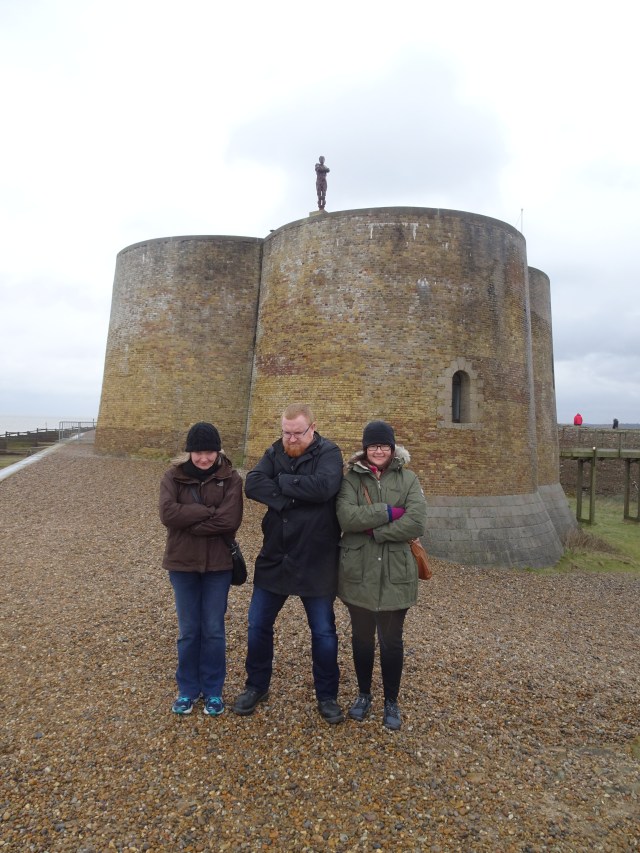
The statues are similar and yet also quite different, but they all perfectly reflect their surroundings. The life-like figures appear to be gazing out to sea, or peering into the ground, some with arms folded, and the one on Lundy appearing to have a rucksack on his back. Four of them are very similar in size and shape but the Lundy one is more boxy and abstract, and doesn’t look as if it is part of the same series. I believe that they have individual names – the Lundy one is officially named DAZE IV for example, and the Saddell one is called GRIP, although we named the Aldeburgh one Cliff, as it was often used as a perch for seagulls (as in the joke Q: What do you call a bloke with a seagull on his head? A: Cliff). Gormley has said that he wanted people to interact with them; to touch them, climb on them, photograph them. I found an irresistible urge to imitate the figures’ pose; and standing at the first one watching for a while I noticed a lot of people doing the same.

I’ve no idea what is going to happen to the statues now; I understand that they are being sold by the White Cube Gallery on behalf of the artist. They may well appear next – possibly individually, possibly together – in a museum in New York or Japan or somewhere else. The fact that they have different names, and the Lundy one being so different, makes me think that they are more likely to be split up and sold individually. I can’t help but feel sad about this; it seems such a shame to remove them from the locations that they were designed for – it is almost as if the location and the view are an integral part of the statue and to separate the location and the statue will diminish the statues. I particularly feel this about the Lundy one, and think it’s a great addition to a beautiful island that I have come to know and love, and I wish it would stay and become a permanent feature of the island. I went to a talk by Antony Gormley in which he said that he liked the fact that they were temporary; it made them more ephemeral and seemingly like part of nature that always changes. I’m just very glad that I managed to visit all five of them in the original locations they were designed for. I wonder how many other people have managed to see the full set that make up the LAND installation and suspect it may be a fairly small number.

Lengthsman’s Cottage, Lowsonford, Warwickshire

This statue is situated opposite Lengthsman’s Cottage, on the Stratford-on-Avon canal. In incredibly peaceful surroundings the figure appears to be gazing into the lock, as though something has caught his attention.


Clavell Tower, Kimmeridge Bay, Dorset

The Kimmeridge Bay statue is situated right in the water, gazing out to sea, so that at high tide the statue is partially submerged under water. The Landmark Trust property of Clavell Tower sits high up on the cliff overlooking the bay. Sadly, stormy seas at Christmas 2015 resulted in the statue toppling over and had to be removed.


Lundy Island, Bristol Channel

Perhaps the most inaccessible of the statues, as to get to Lundy you first need to get to Devon and then take either a 2-hour boat journey in the summer months, or go by helicopter in the winter. The whole island is managed by the Landmark Trust, with a number of properties that you can stay at, or you can go on a day trip. I went on a day trip specially to see the statue, which is on the Southwest corner of the island. Unfortunately, the day I had booked was not great, weather wise, although it does add to the atmosphere as the statue appears to be peering out through the sea mist. This was one of the most controversial statues, as I was aware of many people who love Lundy who thought that it would spoil the natural beauty of the island which is highly regarded for its wildlife and nature. Personally I think it is a fantastic addition to the island, and adds to the wild granite beauty of Lundy rather than detracts from it.


Martello Tower, Aldeburgh, Suffolk

The Martello Tower Gormley is the only one that is actually situated on top of a Landmark Trust property, rather than just nearby. This does mean that it is also difficult to get up close and personal to it as even if you do book to stay in the tower as it is out on a ledge on top of the tower. I stayed for a weekend and it was fantastic to have our own personal Gormley keeping guard and a lookout on the top of the tower, even though with its arms crossed it looked grumpy.

DSC01187

Saddell Bay, Kintyre, Argyll and Bute, Scotland

The Saddell statue, officially called GRIP, is situated in Saddell Bay, on the Kintyre peninsula, looking enigmatically out to see across the Kilbrannan Sound towards the isle of Arran. The Landmark Trust own the whole Saddell estate, with a number of properties including Saddell castle, the grand Saddell House and some smaller cottages, so that 40 people in total can stay on the estate across the different buildings. We stayed in Ferryman’s Cottage, but even if not staying at a property, members of the public can park at the top of the estate and walk down to see the statue. However, it is pretty isolated, and takes a long time to drive to the area from Glasgow or Edinburgh so in reality most people seeing the statue would be staying on the estate.

GRIP stands on a rock at low tide, and at high tide is partially submerged. With the waves crashing against the statue it is incredibly atmospheric and possibly my favourite of the statues. There was an incredible feeling of peace in Saddell Bay, and the statue seemed to change in different lights, weathers and at different times of the tide. But it is the combination of statue and location that really makes it so atmospheric; and again I can’t help feeling that it won’t be as spectacular and effective when removed from its perfect surroundings.


There is very little time left to see the statues before they are removed, but if you do live near any of them or can manage to make a special trip to see them, I would urge you to do so as they are really very special in situ. The Landmark Trust are having farewell events on the weekend of 14th and 15th May 2016 at the Warwickshire, Aldeburgh and Saddell sites, (details here) and I believe they will all be gone by early June. I will be very sad to see them go.

Posted in Art, Landmark Trust, Lundy, Travel, Uncategorized | Tagged | Leave a comment

Masterchef 2016

I first wrote about the television programme Masterchef in December 2015, just as the professional series was coming to a close (you can read the post here). This was the “year of the blob” in which the one must-have kitchen item every contestant needed in order to produce the best-dressed plate was a squeezy bottle with which to decorate the dish with little blobs of sauce.

When the series started again in March of this year, I came up with the idea of a Masterchef bingo card with which you could play along. The card contained the ingredients, techniques and phrases which I thought would be ubiquitous based on previous series. However, sitting down to watch the programme and to play along with the card, I found there were some episodes when I could barely cross off a word on the card, let alone get a whole line completed. One episode mid-series did not feature a single item on the card and I never managed to complete the entire card over an episode.

So what does this mean? Does it mean the show has become less pretentious and clichéd, and replaced the ‘foams’, ‘airs’ and paint-brushed plates with just good quality, honest cooking in which a sauce is called a sauce and not a jus or a coulis? I suspect that this is not the case, it is just that in food, like in everything, fashions change. The most popular word on the bingo card by far this year was ‘puree’, with it featuring in almost every single episode. Seemingly purees are not just for babies anymore, but a ubiquitous item on a posh plate of nosh. The most popular ingredient was beetroot, with honeycomb – so popular in previous series – barely getting a look-in. And amazingly, gone were the contestants presenting their plates with the single-word order “enjoy” but they actually managed more often than not to say “I hope you enjoy it” or just simply “thank you”. Also, hardly anyone declared themselves to be “gutted” when their dish didn’t turn out as well as expected or when they had to leave the show. The bingo card would have been more successful with the words ‘tuille’, ‘crumb’ and ‘charred’ – the latter being a new craze which seems to have taken over the cooking world with far too much aplomb for my liking.

The series has now finished; I was away for the last week with no access to a television, so have had to catch up online. I won’t give the game away in case anyone else is in the same position, but the final three were all excellent and the winner was a very well-deserved one. But I did feel that the series was far too drawn out again. Although the heats were fairly to the point, once it got down to the finals there were some pretty pointless episodes that just seemed to be padding. Like the week when the final four went to Mexico and cooked street-food, then in a restaurant, then producing a dinner for the British Ambassador and guests. An entire episode was spent on this jaunt, which had nothing to do with the competition as no-one was eliminated and they all just seemed to have a jolly time for jolly’s sake. Likewise, there was an episode in which they produced food for the “Chef’s table”, a dinner at which some chefs came and ate their food but again which had no bearing on the competition. I couldn’t help wondering as well whether these esteemed “Michelin-starred chefs” might have their noses put out of joint ever so slightly – after all, these were rank amateurs producing top quality restaurant food and therefore doing their jobs seemingly easily and without years of training. With all this extraneous cooking the ‘final’ has gone from one hour-long episode, to four hour-long episodes in one week, requiring considerable commitment from the viewer to stick with it to seeing the winner crowned Masterchef champion.

After the last episode it was announced that the ‘celebrity’ version would be stating in the summer. I just wonder whether this programme really does have legs to run and run, or whether it is wilting like a charred lettuce leaf and should be consigned to the food waste compost bin? I’d be interested to know what you think – have you got bored with it too, or will you avidly watch another series?

masterchef 2016


Posted in Cooking, television, Uncategorized | Tagged | Leave a comment

#loveparkrun


Across the UK, in fact now across the world, every Saturday morning a quiet revolution takes place. Over 100,000 people of all shapes, sizes and ages get out of their beds and go to a nearby park or playing fields, some to then run 5k, others to volunteer in a variety of roles. And they don’t jut do it on one Saturday, but many do it every Saturday, or as often as they can, as it very quickly becomes a habit that is hard to break.

I’m talking, of course, about parkrun. Started in 2004 by Paul Sinton-Hewitt with a handful of friends in Bushy park, Teddingon, parkrun has grown to become a global phenomenon. Part of its success is that it has stuck to its original principles: that it is a free, weekly, timed run in the park. Much emphasis is put on the word “run” – it is most definitely a run not a race. Although it is timed, with many people chasing PBs (personal bests), there are also local points awarded for attendance and a yearly prize ceremony that rewards loyalty rather than speed. Although such a huge weekly event requires organisation so that parkrun HQ now employs paid staff, the on-the-ground organisation is carried out week-in-week-out by volunteers. Runners who are injured, or resting their legs before a big race, or friends and family of runners, all step in to act as timekeepers or marshals or other roles, so that the parkrun can take place. The volunteers and runners combined make up the parkrun “family”, with many people finding companionship and a social aspect to the weekly run. And with the emphasis also being on the fact that it is free, there are no bars to participation – all are welcome in the parkrun family. This last point has become the source of much controversy and media attention recently with the Stoke Gifford Parish Council becoming the first local council to vote to charge parkrun to use a public park as the venue of the Little Stoke parkrun, on the grounds that it costs them to maintain the pathways that the runners run on. The result was that the Little Stoke parkrun was then cancelled, provoking a storm on social media using the hashtags #lovelittlestoke and #loveparkrun.

My own parkrun habit began thousands of miles away from the UK, in the Wadi Rum desert in Jordan. And no, before you rush to the website to check, there is not a Wadi Rum parkrun – not yet, anyway! I was on a group adventure holiday, travelling around Jordan visiting the various sites such as Petra and Jerash. For one night we got to camp out in a Berber Bedouin tent in the desert. The communal tent was very hot, so many of the group opted to sleep outside, gazing up at the stars. In the morning the outside group assumed that any people not rolling up their sleeping bags outside were inside the tent, and vice versa with the inside people. So it took quite a while to realise that one of our number was missing; Martin, an academic who was in his late 70s. As we were starting to worry, Martin came running across the desert to be quite surprised at our concern. A lifelong runner who had completed many marathons, Martin had woken up early and gone for an early morning run amongst the sandstone pillars. He was probably the fittest person in the group and fitter than people half his age. Talking to him later about his running, I expressed my admiration as I couldn’t run for a bus! I had been thinking for some time that I needed to do something to combat the weight that I had put on, and the realisation that I was pretty unfit, and it came as a shock to be so shown up as unfit by a man in his 70s. The problem was that I have never been a “sporty” person; I hated PE at school, and have never found a sport that I actually enjoyed. Martin told me about parkrun and suggested that I look it up when we got back to the UK to see if there was a parkrun near me.

I did as he suggested and found Walthamstow parkrun that was easy for me to get to. At this point I couldn’t run for a minute so there was no way I was going to be able to run it, but I saw that they were looking for volunteers and so I put my name down. That first time I was given the task of handing out the finish tokens to the runners at the finish line – these tokens have a barcode on them, and the runners take them to a barcode scanner who scans them alongside the runner’s unique barcode so that the runner’s finishing time and position can then be worked out. It wasn’t a particularly arduous job, just standing handing out the little finish tokens in the right order, but it was a great introduction to parkrun. After the start, the volunteers have a good 15 minutes before having to get ready for the first finisher to come sprinting towards the finish line, and so time for a good chat! Everyone was so friendly and welcoming, and I found I enjoyed it so much that as soon as I got home I put my name down for the next week. Very soon I found that I was volunteering whenever I was free at the weekend, doing whatever role was needed, including barcode scanning and timekeeping. I was starting to get to know the regulars – one of the advantages of barcode scanning is that you get to see everyone’s name on their own barcodes, and I was also amazed at how many people would thank me for volunteering. But when chatting to people before the start and after the run, several people started asking when I was going to run it. When I responded saying that I couldn’t run that far, people were encouraging and suggested that I gave it a go, that I could run and walk and it didn’t matter how fast or slow I took.

Various people also told me about the NHS Couch-to-5k plan which takes complete beginners through to being able to run 5km in 9 weeks. I downloaded the app onto my phone, and set off to a nearby park to start the process of learning how to run. That first week consisted of three runs of alternate periods of 60 seconds of running with 90 seconds of walking. It brought me up short as I realised just how unfit I was and what a long way I had to go. Just running for 60 seconds exhausted me, and the thought of running for 30 minutes continuously seemed impossible. But I kept at it, helped enormously when I found a friend who was at the same stage of running and we started running together. I still hated every run, but somehow something was changing, and I soon found that although I hated going out for run, I started to enjoy the feeling I got at the end of the run as the endorphins kicked in. And then much to my amazement, by the time I got towards the end of the training programme, I started to actually want to go out for a run – and realised that I had become a runner!

The first time I turned up at parkrun to actually run it was great – everyone was so encouraging, and cheered me in as I finished. Yes, I had to mix running and walking, and I had a very slow time, but it didn’t matter – I had done it! Since then I have taken part 16 times – I have had setbacks with injuries and many weeks when I have been away or not able to run for various reasons. But it had become such a habit that when I am away at the weekend now, the first thing I do is look to see if there is a nearby parkrun that I can go to. I’ve taken part in 5 different parkruns so far, from Salisbury to Yorkshire, and although they are all very different, they are all very welcoming and friendly. However, like any family member I still feel like I have come home to my parkrun family home of Walthamstow whenever I run there! I am still very slow, and haven’t yet managed to run it without stopping to walk and catch my breath, but it gives me goals to work towards, and I always eagerly wait for the results to come out to see if I’ve got a PB and feel on top of the world when I have. Although I grumble about having to get up early on a Saturday morning instead of having a lie-in, once out I enjoy the fact that I’m up and about before most people have got up and feel incredibly virtuous – it’s a great way to start the weekend. And it’s amazing how many times we can find something to celebrate with cake at the end, with some great cake-bakers that would rival Mary Berry with their creations!

Parkrun is so much more than a run in the park though. It’s also an incredible force for community good. At Walthamstow, one week one of the regular runners organised a clean-up after parkrun, and everyone was encouraged to stay behind and go litter-picking to clean up the playing field producing huge bags of litter:

Then there are the charity initiatives, such as the month in which we were encouraged to donate our “time” to Alzheimer’s UK – a link from the parkrun website converted the finishing time into pounds and pence, or when the founder, Paul Sinton-Hewitt ran the London Marathon last weekend and encouraged every parkrunner to sponsor him just £1, raising over £20,000 for Alzheimer’s UK. Every Friday the parkrun newsletter pops into my email, containing inspirational stories of ordinary people who have discovered parkrun and in getting the parkrun habit have managed to lose weight, or beat depression, or fight cancer or diabetes or other diseases. Or just simply have found it to be a great thing to do with family members or who have found friends and even partners through parkrun.

So if, like me, you never thought that you would be able to run for 5km, think again! To get involved and get your own parkrun habit, you just have to register on the parkrun website to get your own unique runner number and barcode. Then look up to find your nearest parkrun and simply turn up at the parkrun for a 9am start. You’ll soon find it’s a habit that you don’t want to break!


Posted in parkrun, Running, Uncategorized, Walthamstow | Tagged | 3 Comments

Sri Lankan food: spicy and abundant

Not for nothing is Sri Lanka sometimes called the Spice Island. I can’t count the number of times I was told that a dish was “not too spicy” only to feel as though my mouth was on fire as chilli appears to be a staple ingredient in Sri Lankan cooking! The little “Spice Shack” in Galle proudly displayed its write-up in the Guardian newspaper and had all sorts of interesting looking spices in jars and baskets, and I wish I’d had room in my luggage to bring back a tonne of their spicy cashews.

As Sri Lanka is an island, it should not have come as a surprise to me to find fish frequently on the menu, with a local fish called Seer fish rapidly becoming my favourite.

For the second week of my holiday in Sri Lanka I was staying at a yoga retreat that was right on the Indian Ocean, where we could watch the fishermen skilfully rowing what looked like very precarious catamarans through the strong waves to land the boats, and where our evening yoga sessions were punctuated with the cries of fishermen calling out their wares for sale direct from the beach. You could also buy fresh fish direct from the fishermen’s stalls next to the sea in Galle, or from fish markets teeming with all sorts of fish, from giant tuna to king-sized prawns. It was a shame though when I came across three picturesque stilt fishermen to find that they were only posing for tourists, and that they could make a better living from the tip-money that tourists gave them than from fishing from stilts as they would have done for centuries.

As well as fish, there was an abundance of vegetables, including many I had not seen or eaten before like jack fruit which was often made into curries, and red bananas that were not as sweet as the yellow variety. It must be a vegetarian’s paradise – as well as a photographer’s paradise as in every town there were markets with colourful displays of fruit and veg piled high on tables, as well as on roadside stalls. And at a roadside stall I first tried coconut water drunk straight from the coconut with a straw – I think it must be an acquired taste though, and one that I’m not that anxious to acquire!

One of the best meals I had in Sri Lanka was a lunch in a village in Habarana, where huge lotus leaves were used as plates – they didn’t absorb liquid and it was amazing to pour drops of water on the leaf and watch them roll off!

One of my favourite dishes was a coconut sambal that was a bit like Russian roulette – some mouthfuls were cool, light and sharp but others again set my mouth on fire. On my return to the UK I looked up recipes for coconut sambal; there are plenty around including a Delia Smith recipe, and they seem to be very simple to make mostly being just grated coconut with lemon/lime juice, chilli and salt, although some also have coriander and tomatoes stirred through. Another sambal that was delicious was aubergine sambal, that was crispy and also sweet – I haven’t yet found a recipe that replicates the delicious sweet aubergine sambal I had in Sri Lana though.

One of my favourite dishes though was one of the simplest and also a staple dish in Sri Lanka – dhal. Whilst on the yoga retreat we had the chance to go to a Sri Lankan cookery class, but I regret that I didn’t take up the opportunity. I am grateful to one of the yogis who not only went to the cookery class but wrote down the recipes – thanks Steve Pearce!

DHAL (for three people)

6 small red shallots, thinly sliced

150g red lentils

2 lge garlic cloves, thinly slice

1 tsp curry powder

1 tsp turmeric

Lge pinch of salt

1.5-2 inch stick of cinnamon (splintered, not whole)

Half a coconut (desiccated)

7 curry leaves (torn)

Add one cup of water to the desiccated coconut and really mix it in well until the liquid has been absorbed. Squeeze the coconut mixture through a sieve, over a bowl. This is the “reserved” first extraction. Repeat this step twice but this time, the extracted liquid is poured straight into the pan containing all of the other ingredients.

Cook everything for around ten minutes before adding the reserved first extraction of the coconut liquid.

NB1 I’ve since read that the reason that the first extraction cannot go into the pan, is that it is more concentrated, and would likely break down if cooked for the ten minutes.

NB2 Don’t worry too much if it looks as though there is too much liquid in the pan when you first start cooking it – the lentils are very absorbent.


Posted in Cooking, Food, Travel, Uncategorized | Tagged | 2 Comments

Religion in Sri Lanka

I had not given religion much thought before travelling to Sri Lanka, but once there you cannot help but notice it as it is everywhere. I had seen images of giant statues of Buddha in the travel brochure, but didn’t know what to expect and didn’t fully appreciate the role that religion plays in modern Sri Lankan society. It came as a surprise, therefore, to see Christian shrines at almost every street corner in Negombo, or Buddhas in every car and tuk-tuk in Galle, or to go past Hindu temples with every inch covered in multi-coloured statues. The different religions seem to co-exist peacefully, with some temples even being shared by Hindus and Buddhists, and with a Christian church sitting inside the compound of the main Buddhist monastery in Kandy, right next to the sacred Bo tree revered by the Buddhists.

On my whistle-stop tour of the country I was able to visit a number of important religious sites, although I learnt after leaving the country that there are a number of important sites and monasteries that foreign tourists are not allowed to visit. When visiting a religious site I was anxious to ensure that I adhered to any rules and showed respect to the religion concerned, although I found some of the ‘rules’ or conventions rather puzzling. For example, I am used to having to cover up when visiting mosques in Istanbul, or cathedrals in Italy. And so I was surprised to find that at Buddhist sites, although you have to cover your shoulders and legs you have to go barefoot and bare-headed, as it is disrespectful to cover your head in the presence of Buddha. And whilst the guardians of the temple were more than happy for tourists to take photos of the statues of Buddha, taking a photo of the tourist posing in front of the statue was considered disrespectful. I was interested in why it was a ‘no-no’ to have bare shoulders when the Buddhist monks at the site walked around with bare shoulders on display, but when I asked our guide this I was just told “well, they’re monks” as if this should explain it!  At one site we had to take off our sandals in order to climb up an enormous rock barefoot which was rather uncomfortable especially as the stone and rock underfoot became boiling hot under the Sri Lankan sun. But on returning to reclaim our sandals I was rather chuffed to be given a large paintbrush to dust the sand and grit off my soles which worked a treat.
Buddhism is the predominant religion in SL and the country is an important pilgrimage destination for Buddhists from around the world, as it is said that Buddha visited the island three times between 528 and 520 BC. The first Buddhist site we visited was Mihintale, said to be the “cradle of Buddhism” in Sri Lanka, as it is where the Buddhist monk Mahinda, son of the Indian King Asoka is said to have converted the Sri Lankan Kind Davanampiya Tissa to Buddhism, and hence introduced the religion to the island.

From Mihintale, we went to Dambulla where in the amazing cave temples there were more statues of Buddha than you could possibly imagine. It was explained that Buddha is depicted in four poses: standing, seated, teaching and lying down. Of the lying down position, a slightly different position of the Buddha’s feet indicates whether he is sleeping or passed away, although I found it impossible to tell the difference, it was so subtle. The cave temples date back to the 1st century BC when King Valagambahu sought refuge in the caves after being exiled from Anuradhapura. When the king regained his throne after 14 years he converted the caves into rock temples in gratitude to the monks who had offered him sanctuary.

DSC00254

DSC00246

OLYMPUS DIGITAL CAMERA

Photo credit: Ali Shaw

My favourite Buddhist place though was the Temple of the Tooth in Kandy. This enormous monastery is a place of pilgrimage for many Buddhists as it contains a tooth allegedly belonging to Buddha and which is kept in a gold casket inside a shrine in front of which devotees place offerings of brightly coloured flowers. This reminded me a little of holy relics in cathedrals in France, Spain and Italy. Despite being very busy with thousands of visitors, the Temple was actually very spiritual, with a number of different places where you could burn a coconut oil lamp and pray for enlightenment, and the racks of oil lamps with the flames flickering in the sun were very atmospheric.

In Unawatuna on the South coast, the village has become increasingly commercialized and attracts many tourists but it still has a laid-back hippy charm. At the end of the beach is a temple which we were told was used by both Hindus and Buddhists. Overseeing the beach and coast is a Peace Pagoda with Buddha looking down on the hustle and bustle below.

Colombo was not on my itinerary, but looking at the photos of my travel companions on return it is definitely a place I must visit next time!

P2151319 buddhas

Photo credit: Ali Shaw

P2151334 colombo

Photo credit: Ali Shaw

Hinduism is also prevalent in SL, although the Hindu communities are concentrated mainly in the northern and eastern provinces. We visited a couple of Hindu temples but were not allowed to enter inside the temples themselves. My friend and travel companion was Hindu and her grandfather was a Hindu priest so she was able to tell me about some of the stories behind the Hindu tradition but the tales were so fantastical it was difficult to retain all the information! Definitely something I need to read up on.

Christians settled on the Sri Lankan coast in the early centuries AD but the religion, specifically Roman Catholicism, gained prominence only with the arrival of the Portuguese in the 16th century. Protestantism and other Christian denominations were introduced during the Dutch and British eras. Since the end of Colonial rule, the number of Christians has declined to about 7% of the population.

The only Christian church I went in was in Galle in the South of the island, where there is a Dutch Reformed Church built in 1755 on the site of a Portuguese convent with an attractive white façade, and an Anglican church build specifically for the British community in the 19th century. It was interesting to see the list of past vicars in the church change from English-sounding names to more Sri Lankan names.

Islam was brought to SL by Arab traders in the 7th century, but now the community comprises less than 10% of the population, mostly concentrated along the coast. The Meeran Jumma Mosque in Galle looks very similar to the Dutch church and only on closer inspection do you see the crescent and Arab script revealing its true function.

I hope I can return to Sri Lanka someday and do more than merely scratch the surface of the country. As far as religion goes, they seem to have got it right – the different religions sit side-by-side and coexist peacefully and respectfully. It’s a beautiful and fascinating island, and religion plays a big role in making the country an attractive place to visit.


Posted in Photography, Travel, Uncategorized | Tagged | Leave a comment